Sunday, February 12, 2012

DAY TRIP TO MACAU

Last week's day trip to Macau was strictly business. But it gave me some great ideas for a weekend trip sans gambling.

The Macau Ferry Terminal in Hong Kong. The total ferry time to Macau is about an hour.

Pak Tai Temple in Old Macau.
Cute shops in Taipa Village.


We really enjoyed our lunch at Antonio's, which serves excellent Portuguese food. I highly recommend the grilled sausage (which they do table-side) and the duck rice.
Antonio himself whipped up some orange crepes for us for dessert. He is quite the character!
Delicious flaming orange crepes.

After lunch, we went for a short walk around Old Macau before catching the ferry back to the city.

Farewell Macau (for now)!

Tuesday, February 7, 2012

DRINKS WITH A VIEW

When you move to Hong Kong, everyone tells you to go to Sevva for the great views, which is located in the Prince's Building in Central. M and I decided to stop by recently for drinks and dinner. We quickly added it the list of places to take our out of town guests for cocktails. The views are incredible and not to be missed. I also hear it's a great place to watch the nightly light show (A Symphony of Lights).


Dinner at Sevva was excellent. We declared it the best meal we have had so far in HK.

The menu caters to both Western and Chinese clientele. We started with a pork and rice cake dish special that was delicious and reminded me of the spicy pork sausage and rice cakes dish I crave at Momofuko Ssam Bar in New York. For our entrees, I had fish that had been cooked in foil and M had a more traditional Catonese clay pot rice dish. For dessert, we decided to share the green tea ice cream with a caramel cookie crunch. It was the perfect ending to a perfect meal.


The only downside to dinner at Sevva was the massive bill at the end of our meal. The food prices were shocking, even by New York standards. While we can certainly justify the bar tab with the views, we will save our next dinner reservation for a very special occasion.

Monday, February 6, 2012

BOILED WATER? YES, PLEASE!

In the States we are often asked by a restaurant waiter, "would you like bottled or tap water?" I have grown accustomed to answering the question with, "tap water please."

In Hong Kong and many other places throughout the world, tap water may not safe to drink. While the government assures us that the water quality meets the standards of the World Health Organization, there is no guarantee that the pipes in our building have been properly maintained. So for now we will boil our water to be safe.

So how do we boil our water? We use a handy electronic water boiler by Kenwood. She's a real beauty! We prefer an electric water boiler over a stove top kettle because it boils large quantities of water in about half the time.


Below is our recipe for clean, filtered water.

Make sure the water boiler is unplugged. Once unplugged, remove the lid.

Add water. Make sure not to exceed the line marked "full"

Plug in the machine
And let the water boil.

The machine will beep when the water has sufficiently boiled. Unplug the machine and let the water cool.

Once cooled, dispense the water into a water filter pitcher.

And pour. It's ready to drink!
Our water is 100% clean and tasty!

Sunday, February 5, 2012

CELEBRATING CHINESE NEW YEAR

It is wonderful to be in Hong Kong during the Chinese New Year holiday. Waking up to sounds of birds chirping and occasional airplane flying above was amazing. Typically we wake up to the sounds of buildings going up around us. Construction work here goes on 24/7 and only stops on public holidays. The quiet city was very welcoming.

After coming back from Phuket, we were able to spend the last public holiday day relaxing in our apartment. That evening we had dinner with family and played mahjong. Mahjong is a great way to practice saying and reading Chinese numbers.

Our delicious meal with family
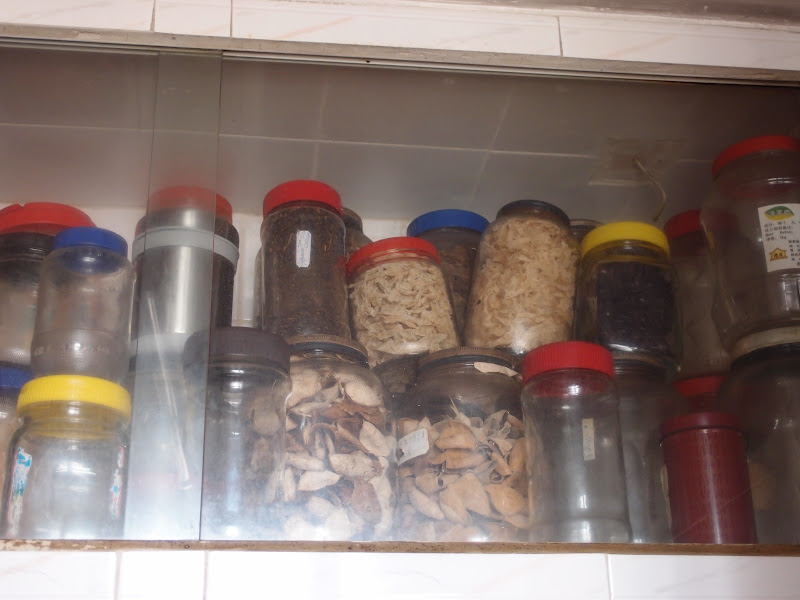
Last weekend, M and I visited the New Territories with family to continue the Chinese New Year celebrations, which go on for 15 days. Our first stop was to visit Uncle Ho, who was good friends with M's grandparents. He and his wife live in government subsidized housing near the Kwai Hing MTR station. While their apartment is only 350 square feet, they make really good use of the space.

Uncle Ho's dried tangerine peels. Each container features tangerine peels from a different year.
After our visit, Uncle Ho and his wife took us to their local dim sum restaurant. This is where M and I had to wash our own dishes before using them. It was a very unique experience to say the least! There we enjoyed some of our favorite dim sum items like turnip cake, rice noodle rolls and dumplings.

After lunch, we said good-bye to Uncle Ho and his wife and headed with M's aunts and uncles to the Yuen Yuen Institute to say our Chinese New Year blessings. On the way to the Yuen Yuen Institute, we got a kick of all the laundry hanging on the public fences to dry. We especially enjoyed the men's boxers!

The Yuen Yuen Institute is a collection of temples, pavilions, monasteries and prayer halls dedicated to Confucian, Buddhist and Taoist beliefs.


While we enjoyed the stunning temples and gardens, our main purpose of this trip was to give thanks for the past year and pray for good luck in the new year. This involved lots of prayers and incense burning.


We spent time thinking of our family and friends, sending lots of good blessings their way. We sent extra blessings to our family members whose zodiac symbol does not interact well with the Dragon. And we prayed to Tai Shui, the deity governing the Year of the Dragon.


After we finished our blessings, we spent some more time walking the grounds and enjoying the beautiful temples.


On a related note, a baby boom is expected this year in China. Dragon babies are believed to be blessed with luck and strength. I hear it's nearly impossible to reserve a hospital bed for delivery in Hong Kong. Our cousin mentioned knowing someone who has to deliver her baby in Canada due to lack of available hospital beds in Hong Kong.

Happy year of the dragon and many blessings to all the dragon babies out there!

Saturday, February 4, 2012

DIM SUM ETIQUETTE


My husband's family is Chinese, so overtime we have shared many dim sum ("yum cha" in Cantonese) meals together. I had never tried dim sum until I met M, so the foods and etiquette were new to me.  And I usually pick up on the etiquette once I have done something wrong. For example, we were at a dim sum restaurant last weekend. Each person was given a bowl and plate. When I served myself soup, I put it in my bowl. When I served myself some vegetables, I put them on my plate. Makes sense, right? Wrong! My husband quietly nudged me and whispered in my ear that I should not use the plate for eating. I quickly put my veggies in my bowl of soup. Now I know that the bowl is for your food and the plate is for discarded bones or food you could not finish.


Knowing I still had a lot to learn about eating out in Hong Kong, I searched for tips on the Internet and came across the website www.virtualtourist.com, which included information on local Hong Kong dining customs.

Boy do I wish I had come across this site years ago! It would have saved me from several embarrassing moments.

 Here are some great dim sum etiquette tips found on the site.
  1. When tea is poured into your cup, tapping the table surface gently with two fingers is a gesture of acknowledgement to say thank you.
  2. If you want more tea, first offer it and pour it for others first, then fill your own cup.
  3. If the teapot runs out, simply lift up the lid and stand it on its side on the teapot, or lift it off and put it on the table. The waiter will fill it for you and close the lid.
  4. Avoid using the bowl one eats from for discarded bones. Instead place the bones on the side-plate provided. 
  5. Avoid touching the food morsels with chopsticks one eats from. Use the serving spoon provided and precise on the bit to be picked.
  6. If someone is serving you food with their chopsticks or spoon, do not accept it with chopsticks. The correct way is to hold out a bowl or plate to accept it.
  7. Offer other people food to be polite and put it in their bowl with chopsticks/a spoon, it is unlikely they will decline,
  8. If you're having trouble eating, lift your bowl to your lips and use the chopsticks to push the food into your mouth.
  9. Do not split the bill (with Chinese friends), this is not polite, offer to pay, but if they firmly refuse, accept it and pay for a meal on a later occasion.

Thursday, February 2, 2012

NAPKINLESS IN HONG KONG


If you're planning to eat out at local restaurants in Hong Kong (and China), plan to bring your own tissue packs, because most local Chinese restaurants don't have napkins. Why the ban on napkins? I browsed the Internet searching for answers. Some suggest it's for the environment while others firmly believe it's to prevent napkin stealing (crazy napkin thieves!). I found many unhappy westerners who have higher dry cleaning costs as a result.

Last weekend, we went to a dim sum restaurant in New Territories armed with our tissue packs. What we were not prepared for was to be seated a table with dirty dishes! At this particular restaurant, it is not only customary to bring your own napkins, but you also need to wash the dishes and chopsticks in a bowl of hot water before eating. Talk about cutting labor costs!